

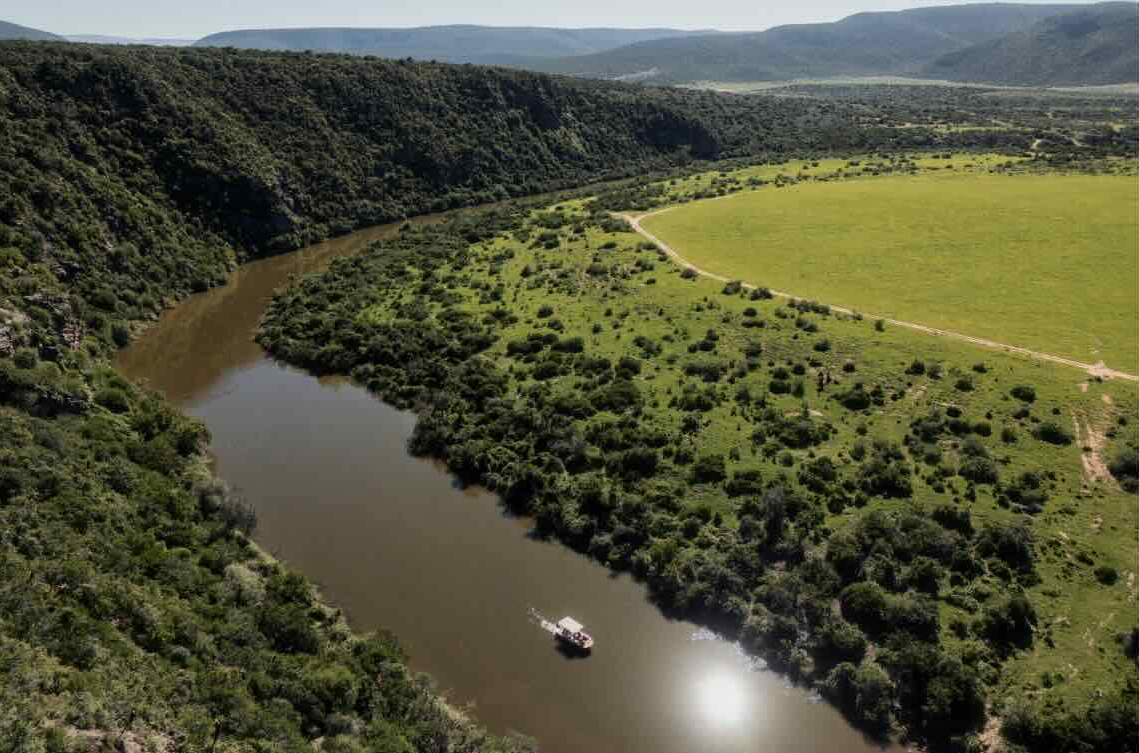
Where elephants now roam through vast bushlands, rhinos graze, and lions prowl the landscape, agriculture was once practiced. The Shamwari Private Game Reserve in South Africa’s Eastern Cape today stands as a testament to a remarkable development: the return of a wilderness that had been largely lost due to centuries of agriculture. Spanning approximately 25,000 hectares of malaria-free land, it combines wildlife conservation with the restoration of natural habitats. The reserve’s history tells not only of the return of the Big Five but also of the close interplay between agriculture and nature, and how much time, perseverance, and knowledge are required to restore an ecosystem to balance.
From Farmland Back to the Wilderness
By the end of the 20th century, the Eastern Cape region had lost a large part of its original biodiversity; centuries of agriculture had altered the natural landscape. Vegetation was pushed back, and land was used for farming, causing wildlife and its habitat to disappear. In 1990, an ambitious restoration project began here at Shamwari: the return of the animal species that once defined the region. In 1992, the reintroduction of elephants, white rhinos, and hippos began, allowing nature to take the lead once again; black rhinos and buffalo followed in 1993. The return of the large herbivores transformed the landscape: the animals loosened the soil, dispersed seeds, and cleared paths through the vegetation. What began as the reintroduction of individual animal species evolved into a comprehensive process of ecological renewal. In 2000, cheetahs, lions, and striped hyenas returned, followed by servals and leopards in 2001. That same year, Shamwari became the first Big Five game reserve in the Eastern Cape, just eleven years after the restoration effort began.
Nature Needs Time and the Ability to Adapt
The return of red-billed quelea from Kruger National Park to Shamwari illustrates just how complex ecosystem restoration can be. At first, the rhinos reacted with panic to the red-billed birds landing on their backs, birds that act as natural tick and parasite controllers, and the project seemed to have failed. But some time later, young honeyguides were spotted in the reserve. The birds had stayed, reproduced, and the rhinos had learned to live with their new companions. A short story with a powerful message: restoration is not a linear process. It requires patience, observation, and a willingness to let nature take its course.
Water as the Foundation of All Life
The drought in the Eastern Cape illustrates just how fragile the balance of a landscape is. Between 2015 and 2023, the region suffered from persistent drought. For a protected area whose habitats depend directly on available water resources, this posed a significant challenge, as water scarcity can be life-threatening for wildlife. At the same time, a lack of water leads to changes in vegetation, contributes to soil erosion, and, in the long term, impairs biodiversity. Shamwari is therefore committed to managing its groundwater resources as responsibly as possible. Electronic well monitoring systems track water levels in real time to control water extraction and prevent overuse. For a landscape whose history is so closely tied to land use, this makes it clear: nature conservation means not only caring for wildlife but also for the natural resources on which animals, plants, and people alike depend.
When Non-Native Plants Disrupt the Natural Cycle
Invasive plants are also among the challenges the team at Shamwari must continually address. Non-native vegetation displaces native plants, depletes water resources, and alters soil composition, thereby also affecting the food supply for wildlife. The Shamwari Foundation works continuously to remove invasive plants in order to curb their further spread. They are eradicated, and their regrowth and new seedlings are controlled. At the same time, the vegetation is regularly monitored and documented to detect changes early on and to accurately identify plant species. Behind the seemingly untouched landscape of a private reserve lies a continuous process of observation, maintenance, and protection.
A Landscape That Continues to Evolve
Today, Shamwari is more than just a habitat for the Big Five. The reserve represents a long-term effort to restore a landscape once dominated by agriculture to a functioning ecosystem. This is not about erasing the past. Rather, Shamwari demonstrates how a landscape can continue to evolve when human use and natural processes are in balance. These developments show that restoration is possible, but not overnight. It requires time, ongoing care, and the flexibility to respond to change. Above all, however, it requires a focus on the big picture: on water and soil, plants and animals, and on the people who take responsibility for this landscape while also benefiting from its new purpose as a private reserve.