

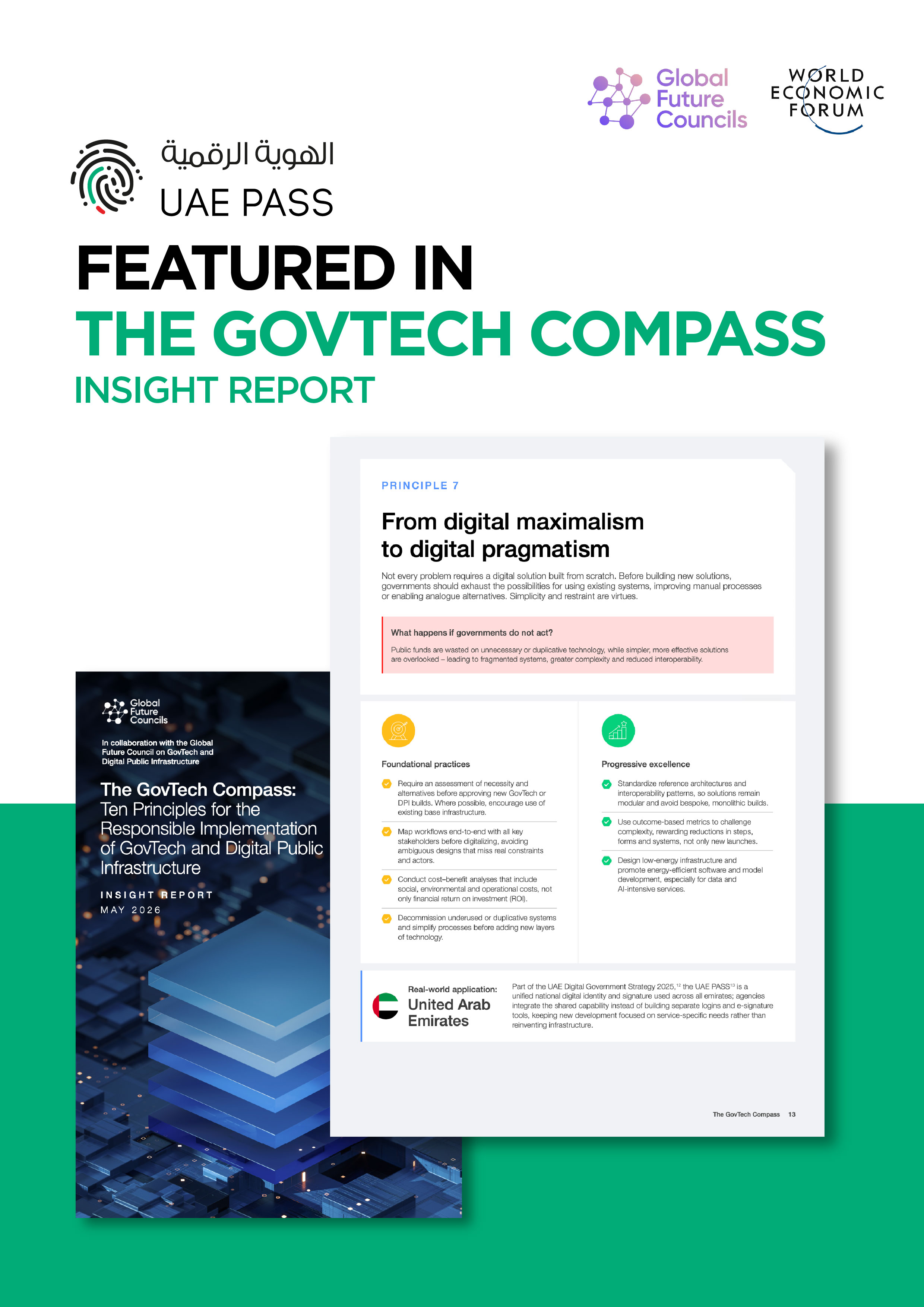
The World Economic Forum has recognized the UAE’s leading experience in digital identity and government digital infrastructure, highlighting the UAE PASS as a global model that demonstrates the maturity of the UAE’s digital transformation and the seamless integration of government services with the focus on promoting trust and advancing a human-centric approach that prioritizes people’s needs over technology. This recognition was featured in a report issued by the World Economic Forum titled: "The GovTech Compass: Ten Principles for the Responsible Implementation of GovTech and Digital Public Infrastructure".
The UAE PASS ecosystem was recognized under the report’s "Seventh Principle", titled "From Digital Maximalism to Digital Pragmatism". The principle recommends that governments establish shared, reusable national digital infrastructures instead of creating separate and repetitive systems across government entities.
Within this context, the report cited UAE PASS as a practical model of a unified digital infrastructure that enables government entities to utilize shared digital capabilities, strengthening government integration, enhancing service efficiency, and delivering improved user experiences.
The section addressing this topic, titled “Real-world application”, states:
"UAE PASS is a unified national digital identity and signature used across all emirates; agencies integrate the shared capability instead of building separate logins and e-signature tools, keeping new development focused on service-specific needs rather than reinventing infrastructure."
Introducing its discussion on UAE PASS, the report noted
"Not every problem requires a digital solution built from scratch. Before building new solutions, governments should exhaust the possibilities for using existing systems, improving manual processes or enabling analogue alternatives. Simplicity and restraint are virtues.
In the same context, the report warned of the consequences of not adopting this approach: "Public funds are wasted on unnecessary or duplicative technology, while simpler, more effective solutions are overlooked– leading to fragmented systems, greater complexity and reduced interoperability.
- Require an assessment of necessity and alternatives before approving new GovTech or DPI builds. Where possible, encourage use of existing base infrastructure.
- Map workflows end-to-end with all key stakeholders before digitalizing,
ensuring the development of practical solutions that are aligned with actual needs and operational constraints.
- Conduct cost–benefit analyses that include social, environmental and operational costs, not only financial return on investment (ROI).
- Decommission underused or duplicative systems and simplify processes before adding new layers of technology.
The report further highlighted how this approach contributes to achieving continuous improvement and progressive excellence through:
- Standardize reference architectures and interoperability patterns, so solutions remain modular and avoid bespoke, monolithic builds.
- Use outcome-based metrics to challenge complexity, rewarding reductions in steps, forms and systems, not only new launches.
- Design low-energy infrastructure and
- promote energy-efficient software and model development, especially for data and AI-intensive services.
The report concluded this section by highlighting the UAE PASS ecosystem as a global benchmark and an experience that offers valuable insights into applying innovation-driven approaches to service development
Commenting on this recognition, H.E. Hamad Obaid Al Mansoori, Director General of Digital Dubai, said: “The World Economic Forum’s recognition of the UAE PASS reflects the UAE’s leadership in advancing an integrated digital model built on trust, integration and a human-centric approach, aligned with our wise leadership’s vision to build a connected government where enhancing quality of life is the driving force behind digital transformation. The UAE PASS has become a fundamental component of the national infrastructure supporting the digital economy and future government services. Through comprehensive collaboration among government entities, the UAE successfully developed a unified digital ecosystem that goes beyond facilitating access to services, providing a foundation for secure digital transactions, proactive services and seamless user experiences.”
H.E added: “At Digital Dubai, we believe that the future of governments will not be defined by the number of applications and platforms they offer, but by their ability to build trusted, integrated digital ecosystems that strengthen community confidence, save time and effort, and empower people to access more efficient, flexible and seamless services.”
In the same context, H.E. Eng. Majed Sultan Al Mesmar, Director General of the Telecommunications and Digital Government Regulatory Authority (TDRA), said: “The UAE PASS ecosystem represents an advanced model of national collaboration and partnership, with TDRA playing a pivotal role in overseeing digital transformation at the federal level, including the development of regulatory and operational frameworks that ensure the reliability, resilience and sustainability of digital infrastructure. We are proud that the UAE PASS is one of our national success stories, offering the world a proven model for trusted digital transformation. It reflects the UAE’s commitment to building a digital infrastructure founded on the highest standards of trust, security, and governance, enabling an advanced, innovation-driven digital economy, enhancing the nation’s readiness for the future of cross-sector digital services, and contributing to the achievement of the “We the UAE 2031” vision.”
For his part, H.E. Wesam Lootah, Director General of GovDigital at the Department of Government Enablement- Abu Dhabi, said: “The World Economic Forum’s recognition of the UAE PASS ecosystem reflects the UAE’s leading position in developing an integrated national digital infrastructure built on trust, seamless integration and a human-centric approach. These achievements reflect the UAE’s vision to redefine government operations through advanced technologies and AI, enabling the delivery of more efficient, seamless and proactive services.”
H.E. added: “In Abu Dhabi, we are advancing the transition towards becoming the world’s first AI-native government by leveraging a unified and interconnected digital infrastructure that enables government entities to exchange data and services in a more integrated and intelligent manner. The UAE PASS is a key pillar of this transformation, providing a trusted and secure foundation for delivering advanced digital people-centered government experiences, contributing to enhance quality of life and strengthening the government’s readiness for the future.”
The UAE PASS is the unified national digital identity. It was developed through a strategic partnership between Digital Dubai, the Telecommunications and Digital Government Regulatory Authority (TDRA), and the Department of Government Enablement- Abu Dhabi, to provide a unified federal digital infrastructure that enables users to securely and seamlessly access government and private sector services, as well as digitally sign documents across the UAE. It is the result of a comprehensive national collaboration and an integrated strategic partnership with the Ministry of Interior, the Federal Authority for Identity, Citizenship, Customs and Port Security (ICP), and the Dubai Electronic Security Center.
The UAE PASS has exceeded 12 million registered users and continues to facilitate millions of digital transactions every year across hundreds of government and private sector services. The ecosystem enhances user experiences and further fosters the UAE’s position as a global leader in digital government.
This global recognition reaffirms that the UAE PASS has evolved beyond being a simple authentication tool to become a key pillar of an integrated digital economy, enabling proactive services, strengthening digital trust, and supporting the development of a unified government experience that is more efficient, flexible and seamless across the UAE.
Meanwhile, the UAE continues to advance its global digital competitiveness, ranking first regionally and 11th worldwide in the Digital Government Development Index, reflecting the impact of government collaboration and the adoption of advanced digital models founded on integration and innovation.
The report link:
https://reports.weforum.org/docs/WEF_The_GovTech_Compass_2026.pdf