
Artificial Intelegence is rapidly changing and developing and due to this people started to change how they discover information. Instead of using traditional search engines such as google or safari, users started to ask every question to AI assistants, chatboxes or apps. As a result; every brand tries to find a soure that AI systems choose to cite and because of that every app has ai form now.
Traditional citations and AI citations both help identify the sources of information, but they differ in how they are created and used. Traditional citations are manually added by authors who directly reference books, articles, journals, or websites they have consulted during their research. AI citations, on the other hand, are generated by artificial intelligence systems to show the sources related to the information they provide. While traditional citations are usually carefully selected and reviewed by the writer, AI citations may require additional verification to ensure accuracy. Both types of citations promote transparency and credibility, but AI citations depend more heavily on user evaluation and fact checking.
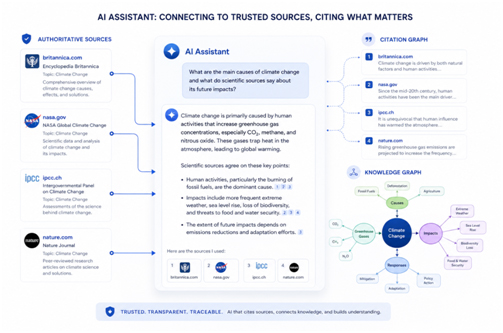
An AI citation refers to a reference that identifies the source of information used, provided, or generated by an artificial intelligence system. AI citations help users understand where facts, data, ideas, or statements come from, making information more transparent and trustworthy. When an AI provides citations, it usually links its responses to articles, books, research papers or websites. AI citations are especially important in education, research, journalism, and professional work beacuse it helps people to get inspiration and keeps misinformation away.
AI citations are important in digital marketing because they affect your brand’s visibility and portrayal in AI responses, which are increasingly prevalent in customer journeys. They increasetransparency, credibility. AI citations make information more accountable, accurate, and useful for informed decision making and learning.
Although AI citations can be used ineffectively when users rely on them without checking the original sources. Sometimes AI may provide incomplete, outdated, or incorrect citations, leading people to trust information that has not been properly verified. Ineffective use of AI citations can also occur when citations are taken out of context or when readers assume that every cited source fully supports the AI’s claims. Therefore, AI citations should always be reviewed carefully and compared with the original materials before being used.
AI citations are not used by only adults, it also plays an important role in education by helping students access, verify, and understand information more effectively. When AI systems provide citations, students can trace facts and ideas back to their original sources, allowing them to evaluate the reliability of the information they receive. This encourages critical thinking and research skills rather than simply accepting answers without question. AI citations also promote academic honesty by giving proper credit to authors and researchers whose work is referenced. Furthermore, they help students explore topics in greater depth by directing them to additional resources, making learning more accurate, transparent, and meaningful.
AI citation refers to the process by which large language models and AI assistants reference, summarize, or rely on information from a particular brand, website, publication, or third-party source when generating responses. In the emerging Generative Engine Optimization landscape, earning AI citations can be as valuable as achieving first-page search rankings. When AI systems consistently mention a company as an authority, that visibility can influence buying decisions, build trust, and drive business growth.
The first step toward effective AI citation is establishing topical authority. AI systems are designed to identify patterns across large amounts of information. Brands that publish comprehensive, accurate, and consistently updated content are more likely to be recognized as authoritative sources. Rather than producing generic articles, organizations should focus on creating in-depth resources that demonstrate expertise. Research reports, technical guides, case studies, and expert commentary provide stronger authority signals than short promotional content.
Equally important is content clarity. AI models extract information more effectively when content is structured logically. Clear headings, descriptive subheadings, concise paragraphs, and straightforward language improve machine readability. Well-organized content helps AI systems understand key concepts and increases the likelihood that important information will be surfaced in generated responses.
Third-party validation plays a critical role in AI citation success. AI systems often evaluate credibility through external references and corroborating sources. Mentions in respected media outlets, industry publications, research organizations, and professional communities can significantly enhance a brand’s authority profile. Digital PR campaigns that generate high-quality coverage can therefore contribute directly to improved AI visibility. When multiple independent sources reference the same expertise, AI systems gain greater confidence in citing that information.
Brands should also focus on data accuracy and consistency across digital channels. Conflicting information can reduce trust signals and make it harder for AI systems to determine which source is reliable. Company descriptions, product information, executive biographies, and key statistics should remain consistent across websites, social profiles, business directories, and media coverage. Consistency helps reinforce entity recognition and strengthens the brand’s digital footprint.
Looking ahead, AI citation will become an increasingly important metric for digital visibility. As AI assistants play a larger role in information discovery, brands must adapt their content, authority-building, and technical strategies accordingly. Organizations that invest in expertise, third-party validation, structured content, and original insights will be best positioned to earn citations from the next generation of AI-powered platforms.
Contributed by GuestPosts.biz