

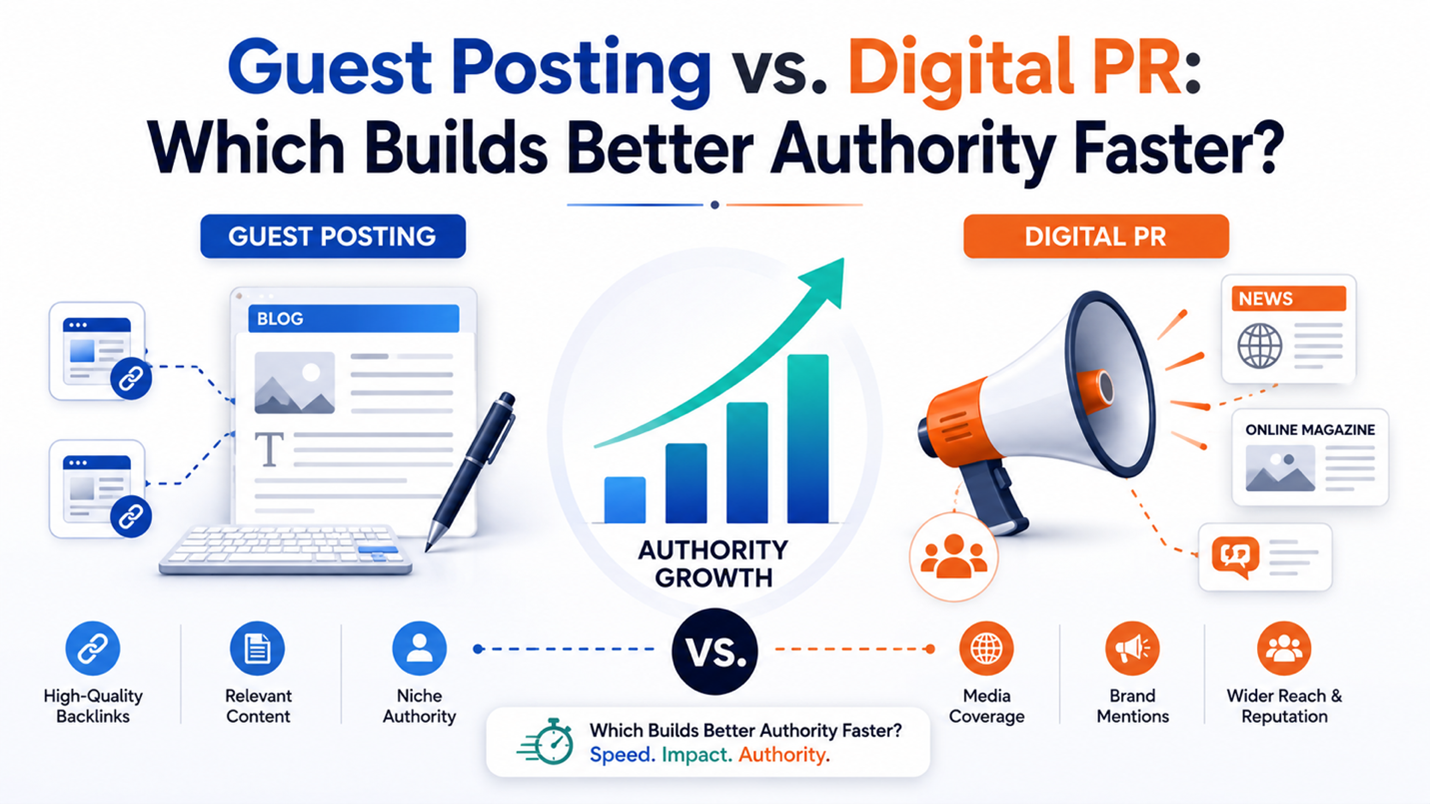
At some point in the last two years, digital PR landed in every content strategy conversation I was part of. Suddenly it was everywhere – in blog posts, in SEO podcasts, in agency pitch decks. The pitch was always some version of the same thing: guest posting is slow and transactional; digital PR is modern, scalable, and gets you into publications that actually matter.
I tried both. Properly, not just dabbling. And my honest conclusion after doing both for long enough to see real results is that the comparison is mostly a false one. They are not competing strategies. They are different tools that solve different problems. But since a lot of bloggers are being told to pick one, I want to break down what that choice actually involves – and who each strategy genuinely serves.
What Each Strategy Is Actually Doing
Guest posting, at its core, is a content exchange. You write an article for someone else’s publication. In return you get a byline, usually a backlink, and exposure to their readership. The value compounds over time because the backlink passes authority to your site continuously, the article keeps appearing in search results, and the editorial relationship you build can lead to further contributions. It is slow by design. The results arrive in months, not days.
Digital PR is a different animal entirely. The goal is not to write an article for someone else – it is to become a source that journalists and publications reference when they are covering a topic. This might mean commissioning original research, creating a data study, building a tool that generates attention, or pitching a genuinely newsworthy angle to a journalist rather than an editor. When it works, you get brand mentions and sometimes backlinks from major news outlets and industry publications. When it does not work, you have spent significant time and money on something nobody covered.
That last part is the part digital PR’s cheerleaders tend to skip over.
The Speed Question: Which One Is Actually Faster?
Digital PR gets credit for speed because when it lands, it lands visibly. A feature in a major industry publication or a mention in a widely-shared news article can produce a spike in traffic and brand awareness that guest posting simply cannot match in a single placement. That is real and worth acknowledging.
But digital PR campaigns fail silently far more often than the strategy’s advocates admit. I ran a data-driven campaign in my second year of blogging – a small original survey, a report, an outreach list of forty journalists. Three replied. One covered it. The coverage was a two-sentence mention with no link. That is not unusual. Industry data consistently shows that digital PR campaigns have a high non-response rate, particularly for smaller brands or bloggers without an existing media profile.
Guest posting has a different failure mode. A pitch that gets rejected costs you the time you spent writing it. A pitch that gets accepted and published produces a guaranteed result – the backlink exists, the article is indexed, the referral traffic is real. The ceiling is lower than a viral digital PR hit. The floor is considerably higher than a campaign that never gets picked up.
For a solo blogger with limited time, that predictability matters more than most strategy articles give it credit for.
The Control Problem Nobody Talks About
One thing I genuinely value about guest posting that took me too long to articulate properly is content control. When you write a guest article, you write it. The editor may ask for changes, but the piece you submit is the piece that gets published, broadly speaking. Your argument, your structure, your examples, your tone.
Digital PR does not work that way. You pitch a story angle to a journalist and then they decide what to do with it. They might cover it accurately and generously. They might bury the mention. They might get the details wrong. They might focus on the part of your research you were least proud of and ignore the finding you thought was genuinely interesting. You have almost no control over the output once the journalist takes the idea and runs with it.
For a blogger whose authority is built on a specific perspective or expertise, that loss of control is not a small thing. A guest post lets you demonstrate how you think. A press mention tells people you exist. Both are useful. They are not the same.
Where Digital PR Genuinely Wins
I do not want this article to read as a dismissal of digital PR. When the conditions are right, it produces results that guest posting cannot touch.
If you have access to original data – a survey you ran, proprietary statistics from your work, a genuinely novel finding about your niche – digital PR is the faster path to major publication coverage. Journalists are not looking for well-written opinion pieces. They are looking for news. Data is news. A surprising finding is news. An argument, however well-constructed, is not.
Digital PR also scales differently. A single piece of research that gets picked up by five major publications produces five high-authority backlinks simultaneously. That is difficult to replicate with guest posting unless you are publishing at a very high cadence over many months. For brands or bloggers at a stage where they need to build authority quickly and have the resources to invest in research or creative campaigns, digital PR can compress a timeline that would otherwise take years.
So Which One Should You Be Doing?
My honest answer: if you are a solo blogger in the early or middle stages of building your site, start with guest posting. Not because digital PR does not work, but because guest posting gives you a guaranteed return on a well-spent afternoon. You research a publication, find a gap, write a pitch, and if it lands, you get a backlink, a byline, and a relationship. The output is proportional to the input in a way that digital PR rarely is at the solo blogger level.
Digital PR becomes genuinely worth pursuing when you have something newsworthy to offer – original research, a tool, a data set, a genuinely surprising finding from your own work. Without that, pitching journalists is a hard sell. They receive hundreds of emails a day from people who think their story is newsworthy. Most of the time, without real data behind it, a blogger’s pitch is not competing seriously in that environment.
you want predictable, compounding SEO authority, editorial relationships, and full control over your published voice. Works at any stage, any budget, any niche.
you have original data or a genuinely novel angle, you need large-scale coverage quickly, or you are at a stage where brand awareness matters as much as backlinks.
Use both when:
you have the bandwidth. They complement each other well. Guest posting builds the niche authority and editorial credibility that makes digital PR pitches more credible. Digital PR builds the brand profile that makes editors more receptive to guest post pitches.
The Real Answer Is Not Either/Or
The framing of ‘guest posting vs. digital PR’ is a bit of a marketing construct. Agencies that specialise in digital PR have an obvious reason to position guest posting as outdated. Content strategists who built their reputation on guest posting have an obvious reason to push back. Both camps overstate their case.
What actually matters is what stage you are at, what resources you have, and what kind of authority you are trying to build. For most independent bloggers reading this -people building something real, with limited time and no PR budget – guest posting is the more reliable, more controllable, and more immediately actionable path. Digital PR is worth understanding and worth attempting when the conditions are right. It is not worth pursuing as a substitute for the slower, steadier work of publishing well in the right places.
Build the foundation first. Then scale from it. That sequence holds up across almost every blogging niche I have seen it applied to, and the few people I have watched skip it usually end up coming back to it anyway.
Key Takeaways
Guest posting offers control and predictability.
- Every accepted pitch produces a real, lasting result: a backlink, a byline, an editorial relationship. The ceiling is lower than a successful digital PR campaign, but the floor is far higher than a campaign that never gets picked up.
Digital PR wins on scale, not consistency.
- When you have original data or a genuinely newsworthy angle, digital PR can produce coverage that guest posting cannot match. Without that, pitching journalists as a solo blogger is a competitive and often unrewarding exercise.
They work better together than apart.
- Guest posting builds the niche credibility that makes digital PR pitches more believable. Digital PR builds the brand profile that makes editors more receptive to guest contributions. Use whichever fits your current stage -and layer the other in when you have the bandwidth.