

In July, I shipped a video about which moats actually survive in a "post-software" world. The thesis: hardware, network effects, regulatory depth, frontier innovation, brand, owning distribution or owning data is what’s left.
Today, I’d like to double click on the hardware moat, how the defensibility moves to physical reality: the atoms.
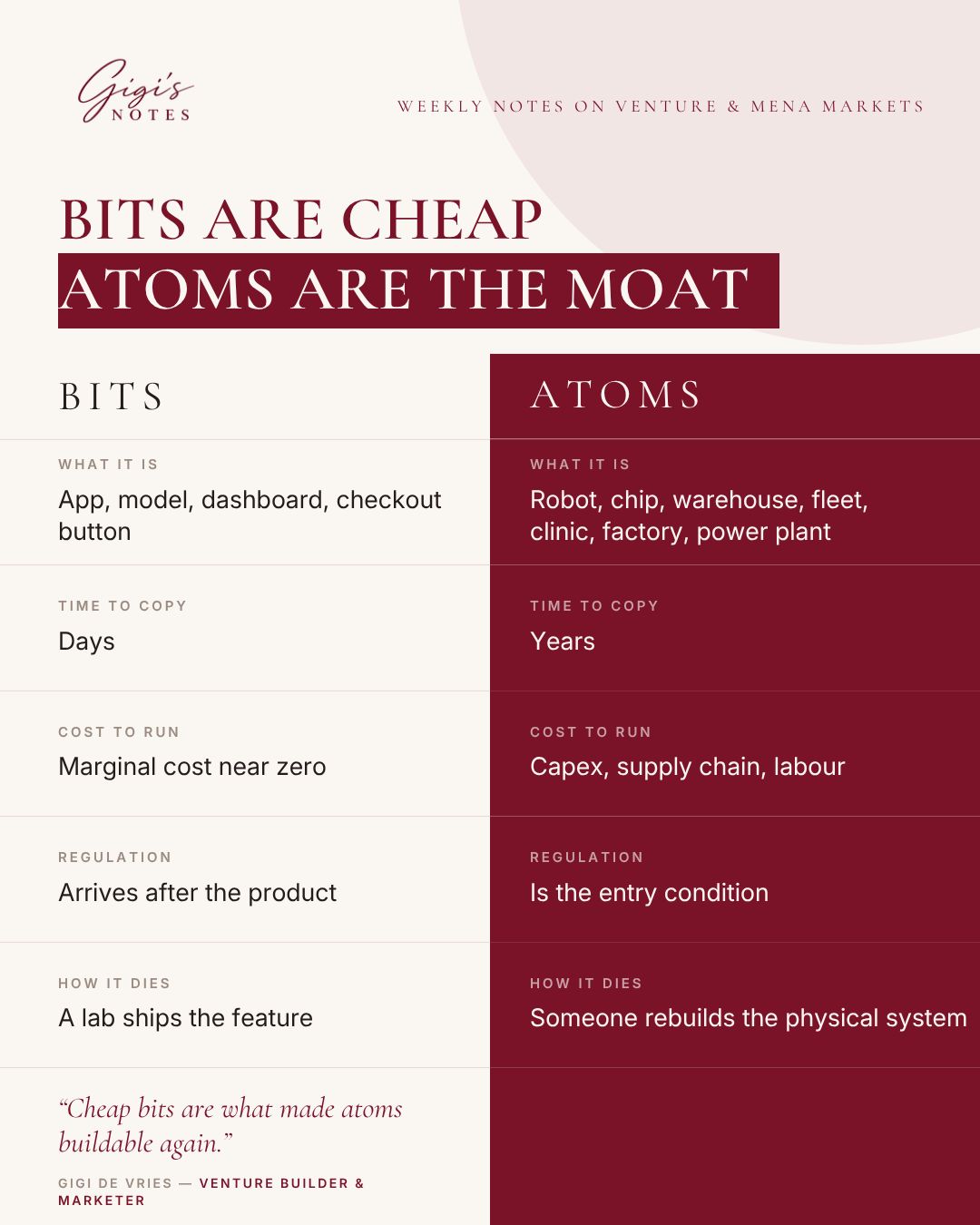
Bits (Software)
- Asset: Apps, models, workflows, dashboards
- Time to copy: Days
- Risk: A frontier lab ships the feature or an AI agent rebuilds it overnight
Atoms (Physical World)
- Asset: Robots, chips, dark stores, fleets, clinics, power plants
- Time to copy: Years
- Risk: Someone has to physically rebuild supply chains and infrastructure
Look at where convergence of atoms & bits hold defensibility:
- Device atoms: Hardware in homes or wearables (XPANCEO , Figure , ŌURA)
- Network atoms: Physical assets & logistics (Snoonu’s fleet, dark store networks)
- Permissioned atoms: Physical + regulatory depth (Geidea 700,000 terminals
behind the first non-bank acquiring license SAMA has issued)
What got me to this framing was last week’s Y Combinator’s read on startups in 2026, and their shift in acceptance numbers show exactly where venture is heading:
- Robotics: 1% → 6-7%
- Industrial Manufacturing: 4% → 10%
- Defense Tech: 1.5% → 5%
- Semiconductors & Photonics: 1% → 4%
- Energy Infrastructure: 1% → 3%
The founder profile shifted with the category. 1 in 6 holds a PhD, and founders in their 30s, 40s, and 50s with deep domain experience in heavy industry, biology, and logistics are becoming the norm. I’m curious to see how these researchers turn into serial entrepreneurs in the next few years.
My take on how this shifts the startup playbook:
- GTM changes: Success now requires regulatory depth, governmental buy-in, enterprise integration, and robust infrastructure from Day 1 rather than relying on cheap customer acquisition loops and treating regulation as an afterthought.
- Brand as a force multiplier: Physical infrastructure provides the initial moat, but long-term trust, community, and brand are what prevent commoditization over time.
So while the convergence of bits and atoms isn’t the only surviving moat, scaling it requires far more than a simple community launch and the brand remains your most powerful compounding moat in the long run.
Author’s Bio

Venture Builder & Brand Lead with 8 years of experience across GTM, brand, and growth strategy across VC, agency, and project environments. I write about building global ventures and MENA markets.